


An insight report into trends within the UK
In the UK, charitable giving, monetary and volunteering, by under-35s is decreasing. A decrease in individuals giving is consistent with the overall downward charitable giving trend in 2024. However, there are reasons for positivity regardless of the downward trend because under-35s represent a constituency with high potential for giving due to their levels of interest in charitable giving. Using SRB’s belief in data informed fundraising, understanding the competing data relating to giving by under-35s leads to recommendations how to appeal to younger givers.
Monetary donations by individuals in the UK have fallen over 10% since 2016 as shown by CAF’s (2025) graph. The graph refers to the ‘proportion of people who donated and sponsored in the past 12 months’. A decline is not seen in every year, with some years witnessing an incremental rise. The overall general trend is downward highlighting the challenge to the sector.
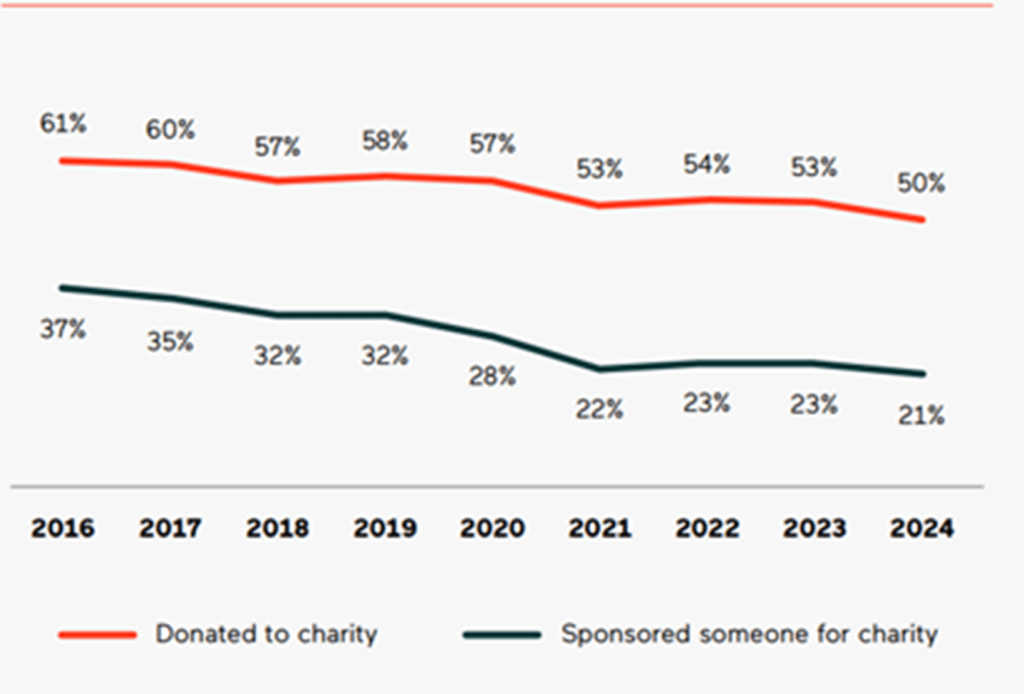
Proportion of people who donated and sponsored in the past 12 months (CAF 2025, p6)
The percentage of individuals under-35 donating to charities matches the overall downward trend of the general population. As shown in CAF’s annual giving report, the younger generations are the least likely to give:
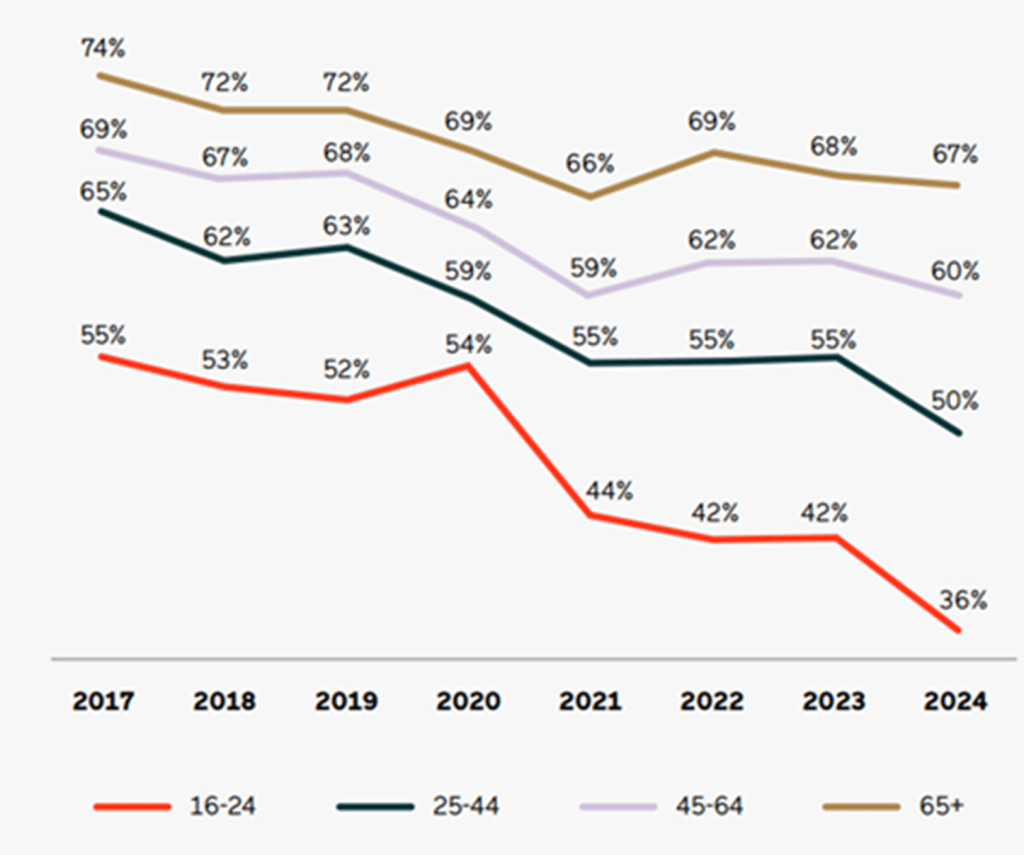
Proportion of people who have donated and/or sponsored in the past 12 months, by age group (CAF 2025, P7)
While the graph does not show under-35s as one single category, the two youngest age categories rank the lowest with 16-24 being the only category under 50%. This seems to confirm that charities are struggling to attract monetary donations from under-35s.
The headline statistics are that the number of under-35s donating money to charity is falling annually and falling at a faster rate than other age categories. Yet for fundraisers, there is positive data suggesting that under-35s are increasingly ‘intending’ to give. Data from Enthuse (2025) and Blue State (2024) suggests that in 2024 younger age groups were the most likely to say they plan to give to charity in the upcoming year.
Blue state produced research suggesting that over 70% of under-35s plan to give to charity in the next 12 months (Blue state 2024, P19). This is supported by Enthuse’s annual report into sector wide donations. Enthuse’s research reported an increase in appetite by under-35s to donate with 54% saying they are more likely to donate to charity in the future (Enthuse 2025, P11).
There is clear data to suggest that under-35s donate more online then in cash. Since the COVID pandemic, cash donations have reduced across all age groups. In 2024 cash donations made up only 36% of monetary donations (CAF 2025, p11).
There is a preference for young donors to give to charity online. Enthuse (2025) report that in the under-35s category, 48% of 18-24yr olds prefer online donations to just 33% preferring cash and 56% of 25-34yr olds prefer online donations to just 24% preferring cash. While over a quarter of the age group do prefer cash so pursuing cash donations should not be entirely ignored by fundraisers, it is clear the majority prefer donating online.
Younger generations are also more likely to donate because of something they saw on social media. The national statistic is that overall, 6% of donations are made because of social media (CAF 2025, P15). However, this percentage doubles to 12% for younger generations (CAF 2025, P15). While still only 12%, at double the effect of the national average this suggests social media is an effective method to attract charitable giving from younger individuals.
Similarly to monetary donations, individuals volunteering in the UK is decreasing. There are different figures presented with CAF stating that the figures have fallen from 17% of the population volunteering in 2017 to only 10% volunteering in 2024 (CAF 2025, p8). NCVO also present the declining trend as shown:
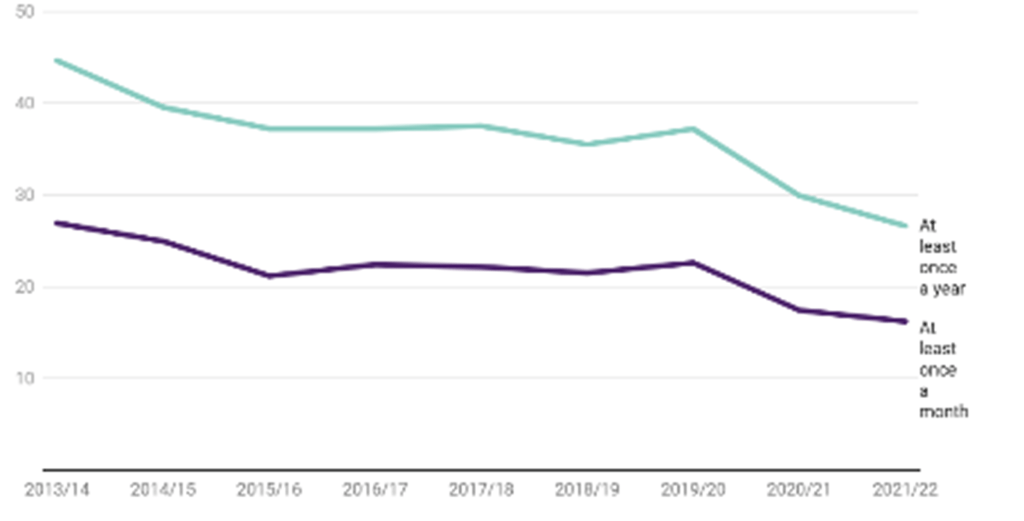
Formal volunteering rates 2013-2022 (NCVO 2025)
While the exact figures differ, both CAF and NCVO highlight the current declining trend of individuals volunteering in the UK.
Similarly to data available surrounding monetary donations, there is directly contradictory data arguing that volunteering by under-35s is rising or falling. Surveys and reports by the British Heart Foundation (BHF) (2023) and NFP Research (2025) argues that volunteering by individual’s under-35 is increasing and is the only age group increasing. This is directly opposite to the NCVO’s Civil Society Almanac stating the younger an individual then the less likely they are to volunteer (NCVO 2025). While NCVO’s Almanac is seen as the definitive publication on the state of the UK voluntary sector, the BHF’s and NFP Research’s reports based upon a smaller demographic offers interesting insights for charities.
While the BHF and NFP Research reports may be based off a smaller pool of participants compared to the definitive NCVO Almanac, they offer interesting insights for fundraisers; specifically, insights around under-35s motivation to volunteer. Both BHF and NFP report an increased level in volunteering by under-35s and state that learning new skills and boosting employability as a key motivation for the younger generation. The BHF directly compared motivations for volunteering among age groups in their survey and discovered that 40% of 16-24year-olds volunteer to learn a new skill, compared to just 18% of over-55s (British Heart Foundation 2023, p9). The BHF’s finding is supported by NFP Research’s study which attributed the increase in volunteering by younger age groups to a culture created by schools and universities who ‘wax lyrical’ about volunteering and the improvement to prospects it enables (NFP Research 2025, p4). With youth unemployment rising from 10.8% in 2019 to 13.8% in 2025 (House of Commons Library 2025), fundraisers can view under-35s volunteering to learn skills and support career prospects as a motivation which is going to continue to grow.
Social Research Builders believe in data informed fundraising to demonstrate the true impact of activities that help inspire donors. When data is contradictory, such as the data surrounding charitable giving by under-35s, then a thorough understanding of the data is essential to inform fundraising decisions.
When witnessing the initial figures, which present a decrease in monetary donations by under-35s, it could be the case that fundraisers do not try to engage with under-35s as they deem it futile. However, by understanding the data and differentiating between ‘intention’ and current giving then the under-35 constituency can be seen as having high potential to give and be future donors. Understanding the data to identify who future donors may be and tailoring campaigns to them, for example younger generations prefer to donate online and because of something they have seen on social media, represents data informed fundraising which can be achieved by researching further then simply the current downward trend.
Just like reports relating to monetary donations, the data surrounding in kind volunteering is equally contradictory. However, despite the overall downward trend in individuals volunteering, the data can inform fundraising actions by highlighting the motivations behind under-35s volunteering. By understanding motivations, charities can be mutually beneficial by offering volunteer opportunities which align with an individual’s motivations while receiving in kind giving in the form of volunteering.
Available at:
Available at:
https://www.cafonline.org/docs/default-source/uk-giving-reports/uk_giving_report_2024.pdf
Available at:
https://enthuse.com/wp-content/uploads/2025/07/Donor-Pulse-2025-Report.pdf
Available at:
https://www.ncvo.org.uk/news-and-insights/news-index/uk-civil-society-almanac-2024/about
Available at:




Our vision is to create a buzzing charity ecosystem where people and places GROW, stories MATTER and stats have SOUL.
Company number: 15546161
VAT number: 505 9336 88